So Why Do Most Businesses Submit Them Like an Afterthought?
Ask most onboarding teams what they do with a corporate applicant's CAC documents, and the honest answer is: confirm the company exists, check the box, move on to the directors' BVN. That habit treats incorporation documents as a formality. They aren't. They're the legal DNA of the business sitting in front of you, and every other Know Your Business (KYB) check you run, UBO verification, source of funds, PEP screening on the shareholders, is only as reliable as the ownership picture these documents establish.
What you're actually holding
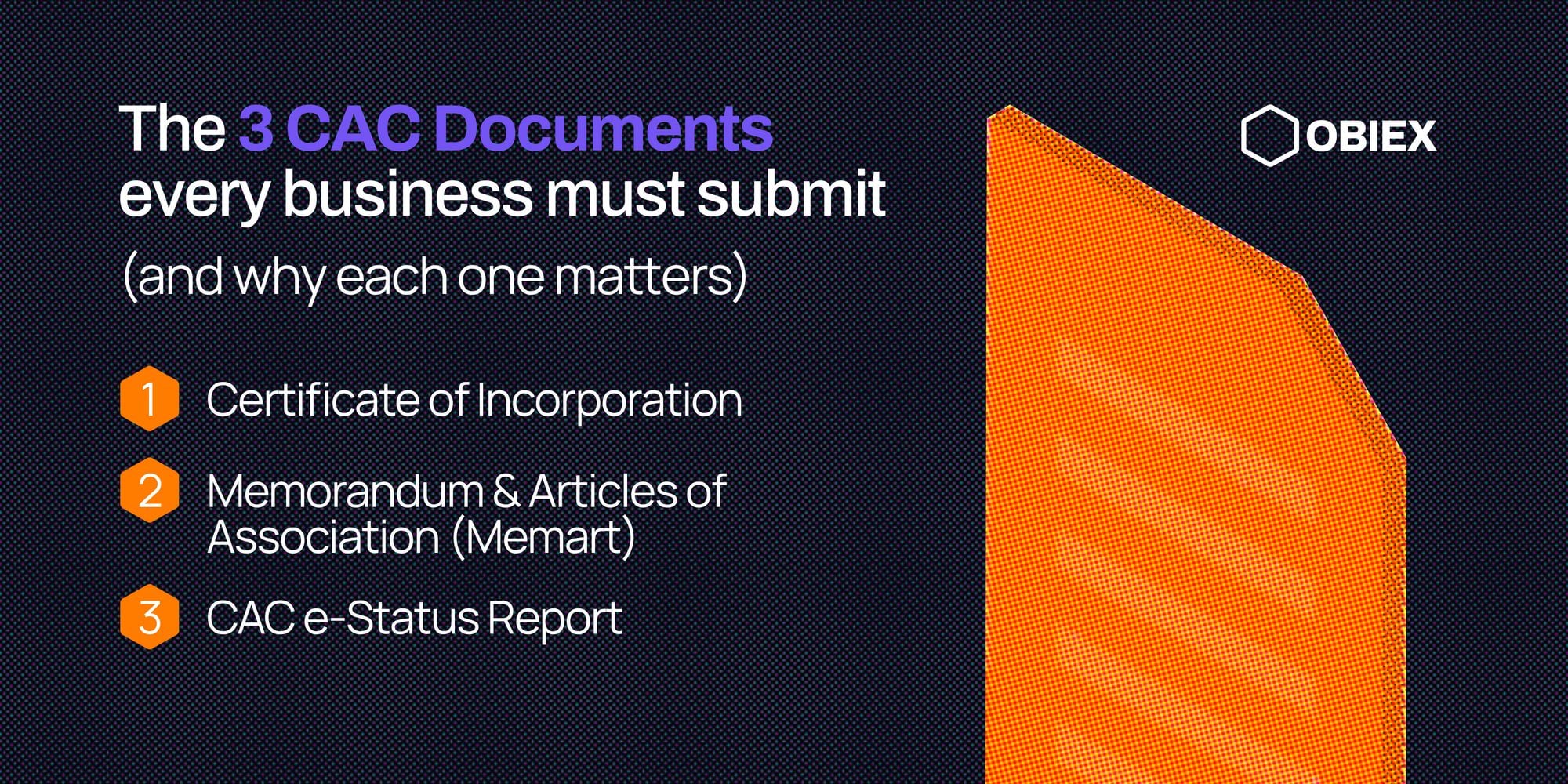
When a company is registered with Nigeria's Corporate Affairs Commission (CAC), it receives three documents that should never be evaluated separately:
- The Certificate of Incorporation: proof the entity legally exists, with its registration number and incorporation date.
- The Memorandum and Articles of Association (Memart): the company's constitution in the literal sense. What the business is legally permitted to do (its objects clause), how shares are structured, how directors are appointed, and how the company governs itself internally.
- The Status Report (now issued as the CAC e-Status Report): a live snapshot of the company's current standing. Registered shareholders and their shareholding percentages, current directors, registered office address, and business activity status.
Notice the word current in that last one. A Certificate of Incorporation is a historical document. It tells you the company was formed, once. The Status Report is what tells you who controls the company today. A business could have changed ownership four times since incorporation, and the certificate would look identical throughout. Onboarding teams that stop at the certificate are verifying that a company was born, not who owns it now.
Where the picture has to match
Here's the check that gets skipped more often than any other: the shareholding structure disclosed in the CAC Status Report has to reconcile, name for name and percentage for percentage, with the Ultimate Beneficial Owner (UBO) declaration the applicant gives you directly.
When it doesn't reconcile, and it often doesn't on first submission, that gap isn't paperwork noise. It's the single most informative signal in the whole KYB file. Either:
- The client hasn't updated their CAC filings to reflect a real change in ownership. A compliance gap on their end, fixable, but a genuine gap.
- Or the declared UBO and the registered shareholder are deliberately different people, which is precisely the structure used to obscure who actually controls and benefits from an entity.
You can't tell which one you're looking at without asking. But you can only ask if you actually compared the two documents line by line instead of filing them both as "received."
The structures that should slow you down
A handful of shareholding patterns show up disproportionately often in cases where ownership is being deliberately obscured. None of them are automatically disqualifying, plenty are legitimate, but each one raises the bar for what "verified" means before you proceed:
- Nominee shareholders. A shareholder listed on the CAC record who holds shares on behalf of an undisclosed party. Nigerian company law permits nominee arrangements, which is exactly why they're a useful tool for hiding a real owner. If a "shareholder" can't meaningfully answer questions about the business they supposedly own a stake in, they're probably not the UBO.
- Layered offshore entities. A Nigerian operating company owned by a BVI holding company, owned by a Mauritius entity, owned by a trust in a jurisdiction with no beneficial ownership register. Each layer you can't see through is a layer where the real controller could be anyone, including someone you'd have declined outright if they'd applied directly.
- Round-number or suspiciously even splits. Ownership split evenly among several shareholders with no majority stake can be entirely normal for a genuine partnership. It can also be a structure designed so that no individual crosses the UBO threshold (typically 5 to 25%, depending on your risk policy) and therefore no individual gets named or screened at all.
- Recently altered shareholding. A Status Report showing an ownership change in the weeks immediately before onboarding, particularly one that removes a previously higher-risk name from the register, deserves a direct question about why the timing lines up.

Incorporation documents anchor everything downstream
This is the part that's easy to underweight: every other check in your KYB stack inherits its accuracy from the incorporation file. PEP screening only works if you're screening the actual shareholders and directors, which requires the Status Report to be current and cross-checked, not just present. Source of funds analysis for a corporate account only makes sense in light of the company's registered objects clause. A business incorporated to trade agricultural produce moving significant volumes of digital assets is a mismatch worth understanding before it's worth funding. Sanctions and adverse media screening is only as good as the list of names you actually ran, and that list comes from the ownership structure, not the application form.
Treat the Memart, the Certificate, and the Status Report as a package to be read together, not three boxes to check independently. The company's constitution deserves the same scrutiny you'd give the constitution of anything else you're being asked to trust.
This article is part of the Obiex Compliance Academy, a series built to help our business customers understand the compliance requirements behind onboarding and working with Obiex. It's for general guidance and doesn't constitute legal advice.