Table of Contents
- Why Crypto Traders Face So Much Pressure
- How Pressure Ruins Trading Decisions
- How to Reframe Your Identity
- How to Build Confidence Without Explaining Yourself
- How the Right Platform Reduces Emotional Trading
- FAQs
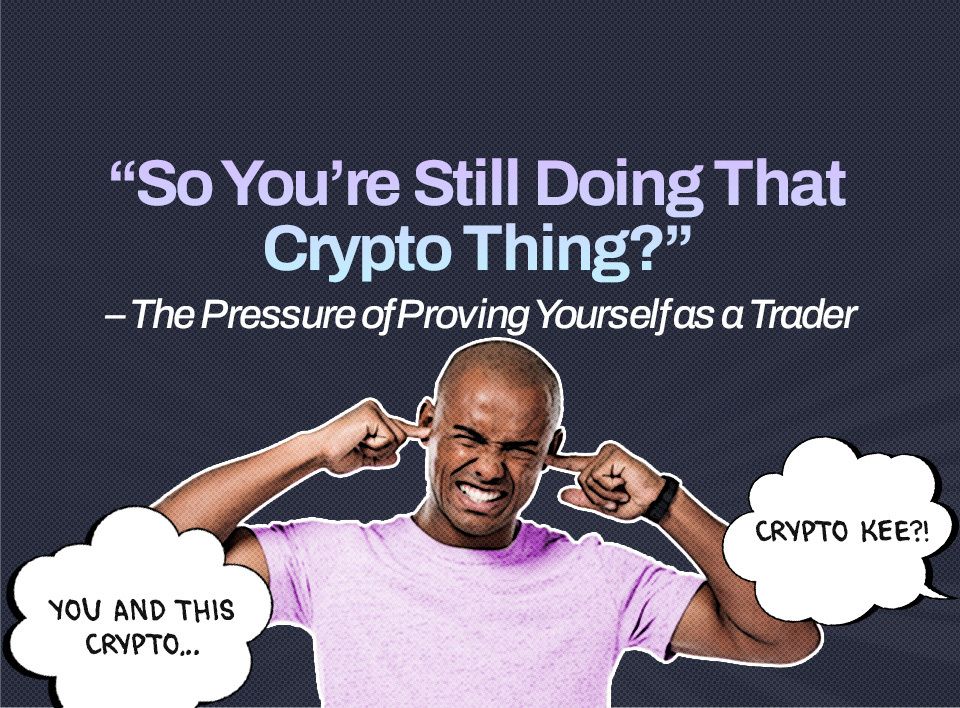
If you’re a Nigerian crypto trader, chances are someone has said this to you:
- “So you’re still trading crypto?”
- “Have you made money at least?”
- “When will you cash out?”
- “Why not do something stable?”
- “Isn’t that gambling?”
They may not say it with bad intentions. But hearing these comments repeatedly does something to you.
It creates pressure.
And pressure leads to emotional trading decisions.
Why Crypto Traders Face So Much Pressure
1. Crypto Does Not Fit the “Recognised Work” Template in Nigeria:
In Nigeria, work is still largely defined by visibility and routine.
People understand:
- A 9–5 job with a monthly salary
- A physical business with daily sales
- A profession with a clear title
Crypto trading does not look like any of these.
There is no office. No payslip. No daily cash handling. No uniform.
So even when you treat trading seriously, by planning, managing risk, tracking performance, people struggle to categorise it as “real work.”
This disconnect leads to comments that create pressure.
The pressure here is not always hostile. Sometimes it’s confusion. But confusion still creates doubt, and doubt seeps into how traders see themselves.
2. Nigerians Measure Success by Fast, Visible Results:
In a tough economy, patience is a luxury.
With inflation, rising rent, family responsibilities, and unstable income, there is a strong expectation that any money-related activity should show quick results.
The problem is that trading does not work linearly.
Even professional traders experience:
- Flat months
- Drawdown periods
- Slow growth phases
But Nigerian society often interprets a slow period as failure.
This creates pressure to:
- Force trades
- Over-risk capital
- Chase short-term wins just to “show something”
The stress doesn’t come from the market alone. It comes from external expectations that ignore how trading actually works.
3. Social Media Has Distorted What Trading Success Looks Like:
Social media has made trading look louder and easier than it is.
Most people only see:
- Profit screenshots
- Withdrawal proofs
- “I flipped X to Y” stories
They rarely see:
- The losing trades
- The blown accounts
- The years of learning behind consistency
- The months where nothing happens
A high percentage of retail traders lose money, mainly due to emotional decision-making and poor risk management.
But social media makes it seem like everyone else is winning fast.
So traders begin to compare:
- Their real journey vs. someone else’s highlight reel
- Their slow growth vs. exaggerated success stories
This comparison creates performance anxiety, which leads to impulsive trading decisions.
4. Family Expectations Carry Extra Emotional Weight:
For many Nigerian traders, the pressure isn’t just personal. It’s relational.
Parents, partners, and extended family often:
- Expect financial contribution
- Want stability and predictability
- Fear anything they don’t understand
So when trading has a bad month, it doesn’t stay private.
You may feel like:
- You’re disappointing people
- You need to justify your choices
- Your financial decisions are under constant scrutiny
This emotional weight affects how traders approach the market.
Instead of trading objectively, they trade defensively, trying to avoid embarrassment or criticism.
That mindset is dangerous because markets don’t reward desperation.
They punish it.
5. The Nigerian Economy Increases Urgency:
Macro conditions matter.
In Nigeria:
- Inflation reduces purchasing power
- Job security is low
- Income is unpredictable
This makes trading feel less like a long-term skill and more like a pressure cooker.
Traders are not just trading charts. They are trading under:
- Financial urgency
- Household expectations
- The fear of wasted time
This urgency shortens patience and increases risk tolerance in unhealthy ways.
How Pressure Ruins Trading Decisions
1. Pressure Pushes Traders to Force Opportunities That Are Not There:
Under pressure, silence feels uncomfortable. If the market is slow, you start overthinking your inactivity.
This is how forced trades happen.
Instead of waiting for:
- Clear confirmations
- Your planned entry conditions
- Favourable risk-to-reward
You enter because you feel you must be “doing something.”
But markets do not reward activity. They reward patience.
Forced trades usually result in:
- Poor entries
- Tight stops that get hit quickly
- Losses that could have been avoided
Pressure makes waiting feel like failure, even though waiting is often the most profitable decision.
2. Pressure Increases Risk Beyond What Your System Can Handle:
When your goal shifts from trading strategically to “proving something,” risk gets distorted.
You may notice yourself:
- Increasing position size without adjusting logic
- Using higher leverage than planned
- Risking more capital on “sure” setups
This usually happens after:
- Friends ask for updates
- A partner questions your commitment
- A period of flat or slow growth
Instead of seeing risk as protection, pressure reframes it as a shortcut.
But accounts are usually blown by one or two over-sized trades, not many small losses.
Pressure compresses judgment. It makes traders deal with emotional problems in the face of financial risk.
3. Pressure Makes Traders Take Profits Too Early:
Pressure is not just reckless when losing, it is also fearful when winning.
Many traders under social pressure:
- Close profitable trades early
- Reduce targets mid-trade
- Exit as soon as they see “green”
Why?
Because profit becomes emotional relief, not part of a system.
You no longer confirm if you reached your target or completed your setup.
Instead, you start thinking about “securing something” at least.
Over time, this leads to:
- Small wins
- Larger losses
- Negative risk-to-reward
Consistency becomes impossible, even if your win rate improves.
4. Pressure Makes Traders Hold Losing Trades Too Long:
Pressure creates ego battles.
Closing a loss can feel like:
- Admitting failure
- Confirming other people’s doubts
- Accepting that they might be right
So traders hold on:
- Ignoring stop-loss rules
- Moving stops further away
- Turning trades into “long-term holds”
This behaviour is rarely about analysis. It is about pride under stress.
Pressure turns discipline into negotiation, and negotiation leads to damage.
5. Pressure Triggers Revenge Trading:
After a loss, pressure spikes.
You get thoughts like:
- “I can’t end today red.”
- “Let me just recover this one loss.”
This is revenge trading.
It often leads to:
- Immediate re-entries
- Ignoring setup quality
- Rapid capital drawdown
Revenge trading is not logical. It is emotional urgency disguised as confidence.
Once pressure pushes you into this state, the market becomes a battlefield instead of a system.
6. Pressure Disrupts Timing and Execution:
Even when traders stick to good setups, pressure affects execution quality.
You may:
- Enter too early out of fear
- Enter too late chasing confirmation
- Miss trades because you hesitate
- Click impulsively without rechecking risk
These small errors compound. Over time, traders begin to believe that their strategies don’t work or that the market is against them.
When in reality, the pressure changed how the strategy was executed.
How to Reframe Your Identity
1. Stop Measuring Yourself by Public Understanding:
Your work does not need to be understood by everyone to be legitimate. When you seek validation from others, you introduce emotional dependency into your trading. Serious traders judge themselves by preparation, risk control, and execution quality.
Once you stop outsourcing your confidence, decisions become calmer and more objective.
2. Separate Your Self-Worth From Individual Trade Outcomes:
A single trade does not define your ability or intelligence. Associating identity with wins and losses makes every chart movement feel personal and heightens emotional reactions. Trading is a probability-based activity, and losses are part of any functional system.
When outcomes no longer determine your self-worth, you become more consistent and less reactive.
3. Build Your Identity Around Discipline, Not Results:
Traders who define themselves by discipline focus on position sizing, risk limits, and rule-following, especially during losing periods. Over time, consistency in discipline produces more reliable results than chasing short-term wins.
4. Redefine What Success Means in Trading:
Success is not constant withdrawals or quick validation. In trading, success is built on controlled drawdowns, fewer emotional mistakes, and steady performance reviews. Many profitable traders grow slowly but survive long enough to compound skill and capital.
When success is redefined correctly, pressure loses its urgency.
5. Treat Trading as a Business, Not an Emotional Test:
Businesses expect slow periods, mistakes, and adjustments. They rely on systems, not moods. When you approach trading with the same mindset, setbacks stop feeling like personal failures and start becoming operational feedback.
This reduces emotional overload and keeps trading decisions clear and professional.
How to Build Confidence Without Explaining Yourself
1. A Weekly Trading Plan:
Every serious trader needs a simple weekly plan.
Your plan should answer these questions before the week starts:
- What assets will I trade?
- What timeframe am I focused on?
- What conditions must happen before I enter a trade?
- Where do I exit if I’m wrong?
- Where do I take profit?
This removes impulsive decisions during the week.
2. A Simple Risk Policy:
Risk is where most pressure damage happens.
Your risk rules should include:
- Maximum risk per trade (e.g., 1–2% of capital)
- Maximum number of trades per day
- A hard stop for daily or weekly losses
- A “no revenge trade” rule after losses
Professional traders care more about protecting capital than chasing wins.
3. A Trade Review Routine:
At the end of every week, review:
- Your last 10 trades
- Which followed your plan
- Which did not
- What mistakes repeated
- What you’ll change next week
This turns losses into data for review.
4. Your Personal Trader Confidence Dashboard:
Instead of listening to opinions, track facts.
Your dashboard can include:
- Monthly ROI
- Win rate over time
- Risk discipline score (did you follow rules?)
- Emotional mistakes count
Your confidence will grow from this evidence.
This system shows real proof, even if no one sees it yet.
How the Right Platform Reduces Emotional Trading
A strong system needs the right tools.
This is where platforms like Obiex matter.
Obiex supports disciplined trading by:
- Providing fast, reliable execution through instant swaps with zero fees
- Reducing friction around conversions and liquidity with internal liquidity pools
- Helping traders focus on strategy instead of platform stress through simple, accessible user interface
- Supporting structured approaches instead of impulsive moves
When your tools are stable, you trade more calmly. And calm traders make better decisions.
You don’t need to rush your process. You don’t need to impress anyone.
What you need is:
- Structure
- Discipline
- A system you trust
- A platform that supports consistency
👉Download Obiex today.Set your rules.And track your results.
FAQs
Q1. How do I deal with family pressure about crypto trading?
Focus on structure. Reduce emotional sharing and let long-term consistency speak.
Q2. How do I prove I’m a serious trader?
Have a written plan, strict risk rules, and performance tracking.
Q3. Is it normal to feel stressed as a trader in Nigeria?
Yes. Financial and social pressure increases emotional load.
Q4. How do routines reduce emotional trading?
They remove decision-making under pressure.
Q5. How long does it take to build confidence as a trader?
Confidence grows with months of tracked performance, not weeks.
Q6. Should I trade every day to prove consistency?
No. Good traders know when not to trade.
Q7. How do I stop revenge trading?
Set loss limits and step away after a losing streak.
Q8. Is crypto trading gambling?
Not when done with risk management, planning, and review.
Q9. What role does Obiex play in disciplined trading?
It provides reliable tools that reduce stress and distractions during execution.
Q10. How do I know I’m improving as a trader?
You follow rules more consistently, not just make profits.
Disclaimer: This article was written to provide guidance and understanding. It is not an exhaustive article and should not be taken as financial advice. Obiex will not be held liable for your investment decisions.